Ar9Jim
-
Posts
4,108 -
Joined
-
Last visited
-
Days Won
205
Content Type
Forums
Events
Articles
Downloads
Gallery
Store
Everything posted by Ar9Jim
-
 Here is some information regarding the various quality levels and standards in electronics manufacturing. Audio is absolutely not an exception. These standards are precisely why the RAM 285 PCBs are assembled at high end suppliers that are comfortable working to the Class 3 standards of medical and aerospace. As a supplier for GE Aviation, the blue ESD coats like the man in the video is wearing were required. Wires connected the jacket to ground while working at a bench to keep you discharged. Only Class 2 level electronics are required for audio, but using ISO approved vendors that work to Class 3, adds value for our customers.
 -
Studio recording. Tom Jung producer. IIRC it was recorded live to a two channel digital recorder. Talks about it in the info.. Earlier digital and it was great on this label.
-
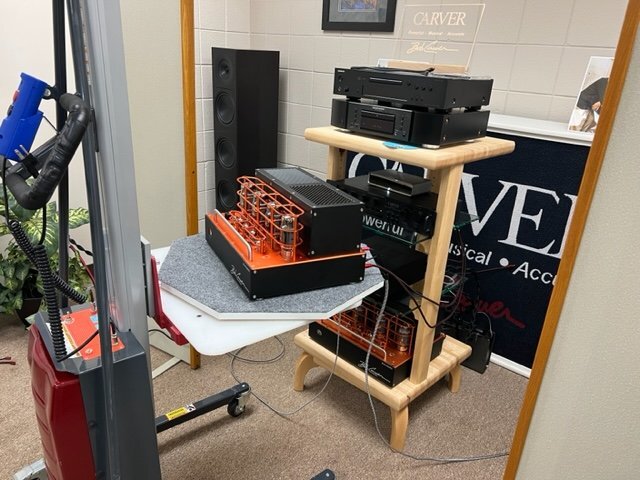
Listening before going to shipping. It's a tough part of this job but someone has to do it. Heavy amplifiers stay right on the work lift through their process, even listening test.
-
I'll mention your concern to Bob and lets see what he says. I'll be back.
-
Topic- Power conditioners with Bob Carver power amplifiers. J. Clark - Bob, you have always recommended plugging power cords directly to the power outlet with your designs, with no filtering or devices in between. Today, it's said that the grid is dirtier and now these devices are needed to clean up AC and reduce distortion in the AC waveform. Customers ask about the need for these products often.. Have things changed ? What is the proper response? Bob Carver - It's still the same. Plug directly to the wall or good power strip. J. Clark - You have said "those devices can not help, but may hurt." Some of the measurement sites have found what you said to be true. Not helping and sometimes hurting performance. Bob Carver - Yes that's correct. You see, any device inserted between the amp and the wall outlet will have associated losses of it's own, regardless. J. Clark - How about noise on the line? Bob Carver - That's all taken care of by the amplifiers power supply. J. Clark - Some say that the devices lower impedance of the AC to improve the dynamics. How about that? Bob Carver - The power supply capacitors are there to lower impedance. J. Clark - How about a lower distortion AC waveform? Bob Carver - Any knowledgeable power supply designer, designs a supply that provides perfect DC power to the amplifier from the wall outlet AC power. There is no need for a conditioner because the amplifiers already have one. J. Clark - Thanks for clearing that up. Direct to the wall for Bob Carver amplifiers. Ask your amp designer for their advice. Maybe some poor designs would benefit, but AC conditioners are not advised with a Bob Carver amplifier.
-
Topic: THD+N in Bob Carver tube amp designs. There are many conflicts between Bob Carvers design philosophy and the mainstream audio "beliefs". Some are of the belief that the lower the number the better the sound will be. Some believe that a lower number equates to an improvement in musical performance and the association of sound quality improving with ever lower numbers. Many of you have been in this hobby for decades and have experienced many products. The product that had the best numbers is not likely what you are using today, am I right? This may be interesting to the 'listen to the numbers' types. This is from a recent conversation with Bob Carver about the numbers on the production RAM285, some will find it enlightening. J.Clark - Bob I just emailed graphs from the 1st production RAM 285. Please call. Bob - I see the voicing in the graphs (details deleted) , that is great. I'm glad to see they didn't try to improve it and screw it up. J.Clark - Well our team is from aerospace and you never make changes to a design without authorization. It won't happen. Bob - THD+N of .2-.3% that's great too. If it were any better than that, I would know they tried to improve my design and likely messed it up. J.Clark - That's very interesting Bob. It's all your design. Bob - Jim, you have no idea how uncommon it is, to not have a manufacturer change my design, trying to improve it, meaning well, but messing it up.. These are really great results. They will sound wonderful. J.Clark - They are all your designs Bob. We would never make a change to the design without your approval. Bob - This is great. Lets roll.. I hope sharing these conversations helps you understand Bob physics based view of these topics. Bob doesn't follow, he leads. Notice if the team would have improved the numbers, Bob would have known we tampered with his design, not happy we improved it, but upset that we improved it measurement wise, and messed it up. Big difference in viewpoints. Powerful - Musical - Accurate.
-
Hi Bob, Just prints at the moment. Haven't made 3D solid models yet.
-
Good. Chassis and faceplate tooling is ready. Hoping to make good progress on the boards in November.
-
Jim, Why are ISO certifications and registrations of suppliers and vendors required by Bob Carver Company? It's all about customer value, quality and preventing counterfeit or substandard components from entering our supply chain. I'll explain. Today, component parts and processes are provided at a wide range of locations around the world. Transformers from Canada and USA, potentiometers from Japan, automated board assembly and integration in China, manufacturing engineering in Germany, final inspection and test in USA. This is a broad base to monitor for small companies that make niche products. Gone are the days of having people living abroad just to monitor quality to assure the suppliers were not cutting corners and using counterfeit untraceable parts in your assemblies. Bob has been to Japan for these reasons, back before the information age. At that time, Japan offered excellent quality and value, but you still needed boots on the ground for quality control. Enter ISO. International Standards Organization. At the former aerospace manufacturing company I founded in 1996, we witnessed a change to ISO or higher yet AS certifications being required to continue doing business in aerospace. All companies working in aircraft, military and space were required to have AS quality management systems in place with full traceability back to the source. It's accurate to say the traceability begins when the materials come from the ground. Our company was audited by ISO/AS auditors every 6 mo. for 2-3 days at a time. They pull paperwork on random jobs and follow the traceability though your certified vendor list. You can only use vendors that also meet these requirements. If you have a "finding" during an audit, it could result in you losing certification and disabling your company. It's life and death in aerospace and more serious than a heart attack. This is how it's done, imho.. Bob Carver knows these requirements from interacting with his engineer and physicist friends at Boeing in WA.. Boeing has the same AS certified quality management system. It's uniform and world wide. It works. ISO is very good. We know the quality management system in place at the vendors very well. While we don't need AS certification for amplifiers, ISO gives us the quality assurance required to keep the quality of Bob Carver amplifiers truly World Class..
-
Good question. In the case of RAM 285. Designed, tested and serviced in USA. Assembled in China from globally sourced parts. The best source we could find for automated assembly that could meet the required ISO certifications, with the best delivery and price is a company called ABP.. Our criteria is quality, delivery and price, in that order. ABP has great technology and huge capacity in both SMT and Thru-hole assembly. We have north American sources coming on-line as well, to prevent disruptions from politics, natural disasters, etc.. Interestingly, the north American sources also use boards from China or Taiwan. There are some items that can't be found anywhere else. ABP is doing great. We are very happy with them as a supplier. The quality is top notch. Originally, we planned to do the final integration of the boards to the chassis here in Rockford, but ABP had a lower cost to do that operation than we quoted doing it in Rockford, so they won the job. The assembly is excellent and the finish is flawless. The component parts are sourced from Mouser regardless of assembly location and we receive Certificates of Conformance traceable to the manufactures to assure counterfeit parts do not enter our supply chain. Mouser provides the required documentation for ISO/AS quality system compliance. Our 285 transformers are purchased in matched sets from Hammond in Canada. Black Magic 25,275, 350s transformers are made by 2 sources in California. With fully digitized product designs and process engineering, we can respond quicky to world changes not being locked to one supplier like in times before the information age. From a process engineering view, we must have options and flexibility to prevent 'single point sources of failure' in the supply chain. Note during COVID, how state of the art companies were able to move their production as needed and minimize disruptions to their supply chain by moving 'data' between sources, where ever they were found. This minimized the impact on their customers. World Class. The Black Magic 25s and 275s are assembled in California. The Black Magic 350s are assembled in California The Sonic Hologram Generator is being assembled in Rockford The Phono Preamp is being assembled in Rockford The RAM 285 is being assembled in Shenzhen The RPM V12 is being assembled in Shenzhen All from globally sourced parts. Final quality control inspections, measurements and documentation of all products and warranty registration is in Rockford. Even the Rockford plant has to provide the best quality, delivery and price and compete, by offering the greatest value added processes for our customers. Quality, delivery and price, in that order.. Here is a video about ABP.. Good people. Excellent quality. They make more than 30k boards per month. Our boards are custom multi-layer per specs.
-
New member from Minnesota USA
Ar9Jim replied to papa-j's topic in The Welcome Shop (Please read first)
Welcome to TCS, Sir. Good to meet a man from the land of Magnepan! -
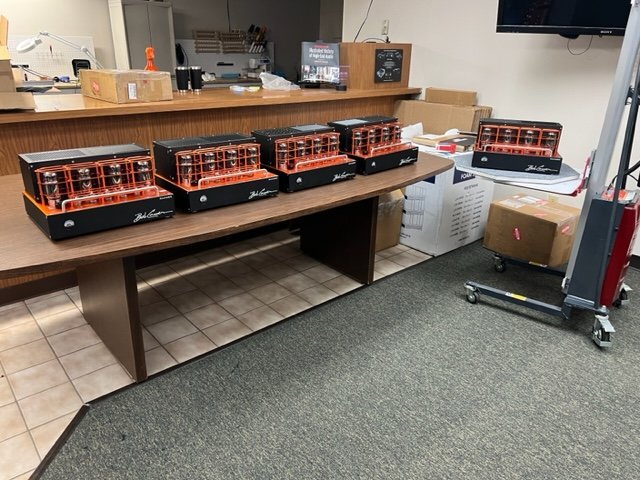
Getting the ducks in a row.
.jpg.a0605d268044af368c45864737c7afe9.jpg)
-
Some of the boards with the lifting traces are a pita.. Too many times, I didn't lift off the trigger on a solder sucker before lifting it off the solder pad and lifted the pad off the board. Interesting to be old enough to see these improvements over time. 1960s like that Dynaco to 1990s while they were generally a lot better, but still not so good for tube amps, to 2023 when you can call out copper weight and the specs engineers want. Even DIY. Good times really.
-
"They don't make 'em like they used to." Oh man, that's a good thing.. I don't miss drum brakes or bias ply tires either.😊
-
Agree Greg. Point to point does have some upside. Our boards are custom made. The materials, copper weight, etc. are called out in the design. Computer design software really helps avoid issues ahead of time. Voltage creep, EMI and other issues are avoided. Here is an example of the vintage boards that were basically junk. This is where the circuit board 'truths' that are now myths originated. They were terrible. Check out the thin warped board. Note the burned area on the opposite side from the tube socket. Note how poorly it is mechanically attached. Imagine pulling and pushing tubes out of the socket attached to the thin crispy wafer of micarta? Will the traces survive? I'm not sure, but it appears there may be signs of voltage creep between traces, what do you think? Here is a multilayer thick high quality, state of the art heat resistant board. Heavy copper traces computer aided design. Gold plating to prevent oxidation. Vent holes for air flow. Note the mounting screw locations to support the board properly eliminating flex. Lower noise floor. Reduces the cost of the final product to the customer by a large margin.
.jpg.2c4c05f2ecee88ae754694fbb23b4274.jpg)


-
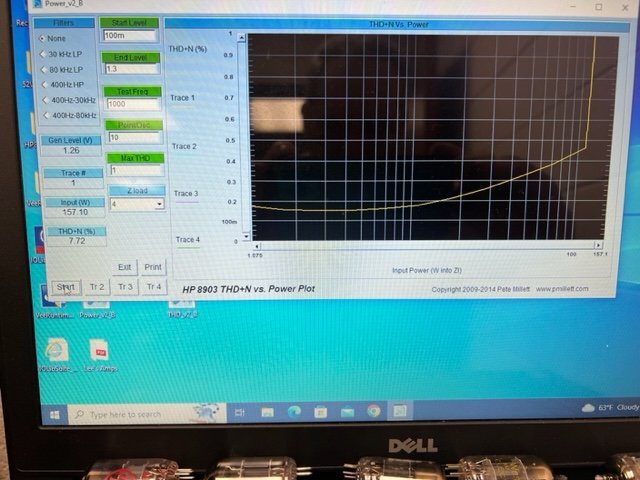
Hi Wayne, Here is a test of both channels driven 4 ohms this time. With both channels driven it made 125w at .46% THD+N and when the test stop it was 157w @7%. There is a frequency plot shown both channels driven. There is a .25 db dip by design. This is at 5 watts as tested by many. The FR is the same at full power. My low buck 10a variac on the shelf (red). Bob's on the shelf is a 22a big guy. Note this is not +- 3 db. This is plus only 1.1 db at @25 KHz.



-
Just 1 this time. I'll try 2 next and we can compare. The power trans should good for about 350w.. At 1K the output trannies should be fine. I'll post FR at a 5 volt output spec and at rated power, also.. Flat line past 18hz with no roll-off at 20Hz.. Bad ass tube amp.. Fun stuff! Today the bias resistor values are being adjusted to allow the bias pot slightly more range of adjustment to the higher side.
-
At 180 watts THD+N was at 7% when the test ended at more than double the rated output. It seems to be sort of accepted that 3% may audible. The overheating of tweeters from hard clipping of solid state is due to the tops on the nice smooth waveform being clipped off flat. To the driver, instead of having a wave flow when changing directions, it becomes more violent and abrupt. The heat goes up and bad things happen. With tube amps, the THD+N goes up, the wave form tops get distorted, looking thick and fuzzy at the peaks on a scope, but is easier on tweeters. I've only used the 285 on LRS+ and MGIIIA maggies. Xavionics was at the factory and we kept reaching over and turning it up a little more. The maggies were punching like dynamic bass drivers and the thought of film punching like that, made us stop out of fear for the maggies health. No blow fuses and no audible distortion.. Honestly, we looked at each other with amazement and Xavionics says "85 WPC, yeah right!" Bob hit a homerun. A true legacy product.
-
It's actually a bead blasted finish with copper anodize.
-
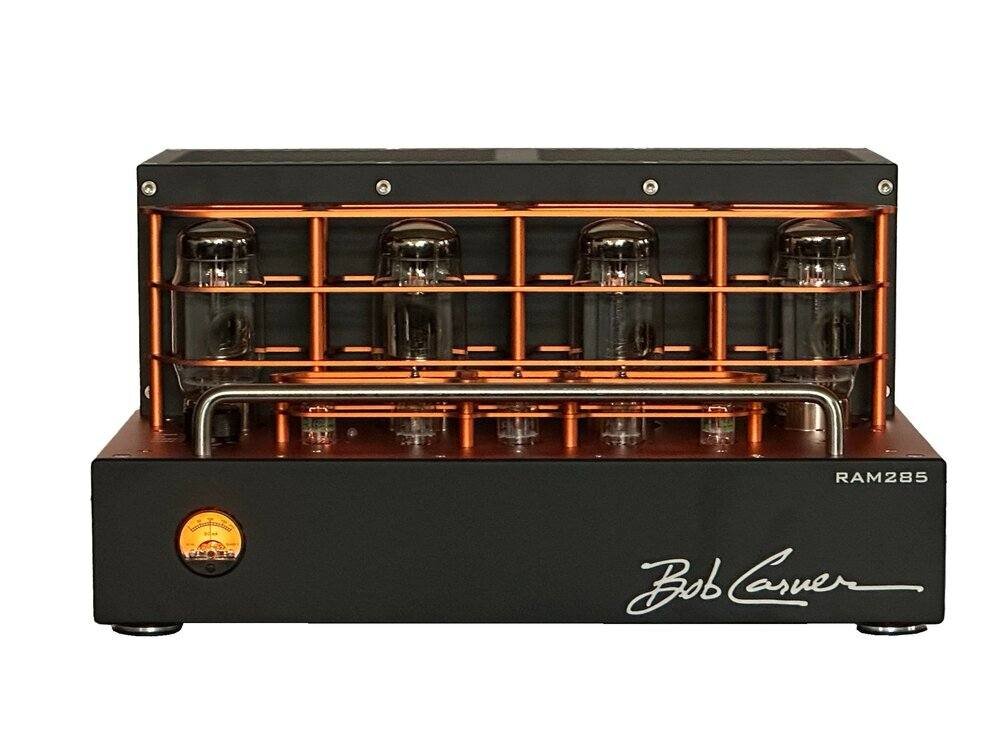
Today is a great day. RAM 285s are arriving and looking great. Initial test are great. The 285 is an overachiever subjectively or objectively running transducers or resisters. Here is the standard 1KHz power test driving 8 ohm resistors. The 85 watt amp made 125 watts at .3% distortion. This test was using a calibrated HP8903B using some free software available on-line. The Audio Precision analyzers have greater resolution than the HP8903s, but our quality manual requires that the test instruments have a resolution 10x greater than the tolerance allowed. The HP8903 meets this requirement well. At this moment the capital expenditure to replace the HP8903 isn't justifiable. Those who have experience tube amps know 125 watts is a lot of power, especially with no roll-off until below 20Hz. Pictures tend to make these look an odd color, but they are almost a perfect match for freshly stripped copper wire. Note one picture has a piece of copper wire placed on the chassis for reference.


-
Modern PCBs vs Point to point- Is point to point still better? With the point to point wired, 350 watt mono-block amplifier production coming to an end, the topic of point to point wiring vs modern printed circuit boards (PCBs) is a relevant topic to talk about. My background is in aerospace manufacturing and the state of the art processes used by the most highly regulated industry. It's through this lens that my view is filtered. The PCB was patented in 1956.. Having enjoyed restoring vintage tube amplifiers, its common to see PCBs from the 1960s that are burned and heat damaged. The thin, poor materials were poor at holding tube sockets. After the boards were exposed to heavy heat cycling from scorching hot tubes, the thin material could become carbonized and increased in conductivity, increasing noise from voltage creep between the often undersized traces. The thin boards would become brittle around the tube sockets. Changing tubes would often crack the well cooked boards and traces. If you have restored vintage tube amps, you have seen all of this for yourself. The materials were 1960's. Material science and engineering has not stood still for 60+ years any more than the design technology and materials used in automobiles from 1960 to 2023. You will still find some that would proclaim the 1960 autos better than today, but they are few. The saying, 'the best excuse for the good old days is a poor memory' comes to mind. The truth is, the old timers were right and the old PCBs in tube gear was a bad idea for longevity and audio performance. Point to point was the only way to go for an heirloom product to be passed down within generations of a family. Service life, noise level, measurable performance, hands down, point to point was worth the investment. It's 2023, these are not your fathers or grandfathers PCBs.. When do old facts become myths? Today our boards use heavy copper traces. The boards are multi-layer to allow for copper layers in-between, to be used as ground planes to isolate parts from each other when located on opposite sides of the board. This technology is a big step forward in noise reduction. We have now achieved lower noise levels with hi end PCBs than using point to point wiring. The high temp materials of today, combined with Bob Carvers cool running designs have made heat damaged and carbonized boards an issue in the past. The heat ratings of the modern materials could only be dreamed of in the 1960s. Today, the multilayer modern board materials and thru-hole plating of the tube socket locations, combined with proper mechanical mounting of the board to the chassis, has made board flex an issue in the past. Voltage creep between PCB traces is no longer an issue. The computer aided design knows the voltage in the traces and prevents spacing that would allow voltage creep to happen. Computer simulation is a tool only dreamed of in the 1960. Leveraging technology and science to provide a high end audio performance, at prices more people can afford has always been a worthy goal for Bob Carver. Today is no different. Delivering the highest customer value and sharing Bob's work with as many people as we can is the goal. Leveraging state of the art manufacturing technology, quality control and efficiencies for maximum performance and maximum value added for the customer is the path we are on. As always, Bob is all about pushing the cutting edge and improving performance. Combining the highest tech available with vacuum tubes is the way to truly advance tube amp performance.
-
Welcome to TCS.. Have fun. Enjoy!
-
It's a good day for a good day.. 285s start shipping next week. In on Monday out before Friday. This has a good chance of being the quietest tube amp available. It will be fun when they get out in the field. The guys with the 'measures best, so it sounds the best' mentality are already pigeon-holed to solid state only, but as far as tube amps go, this should set the standards for it's class. Both objectively and subjectively as Hugh Dean said when he simulated it as a consultant to confirm our simulations. Hugh confirmed the RAM 285 as good as we thought it was.. The reaction from Manufacturing Engineering was "Wow, Bob did this without simulation, using a calculator! Just about every tube amp starts to have some roll-off below 60Hz or so. This leads to the old assumption that tube amps are less desirable for bass frequencies. Not the 285. At full power frequency response is flat below 20Hz on a resistive load test at about .4% THD+N. Bob said he could take THD+N down to solid state levels, "but it would add complexity and have no sonic value." Most tube amp manufacturers spec FR at 1W.. The ASR test is at 5W.. Ram 285 is w/n minus 1-2 db at full power. The minus is at 20KHz It's a legacy product as intended
-
Welcome to TCS Jeff. Enjoy!
-
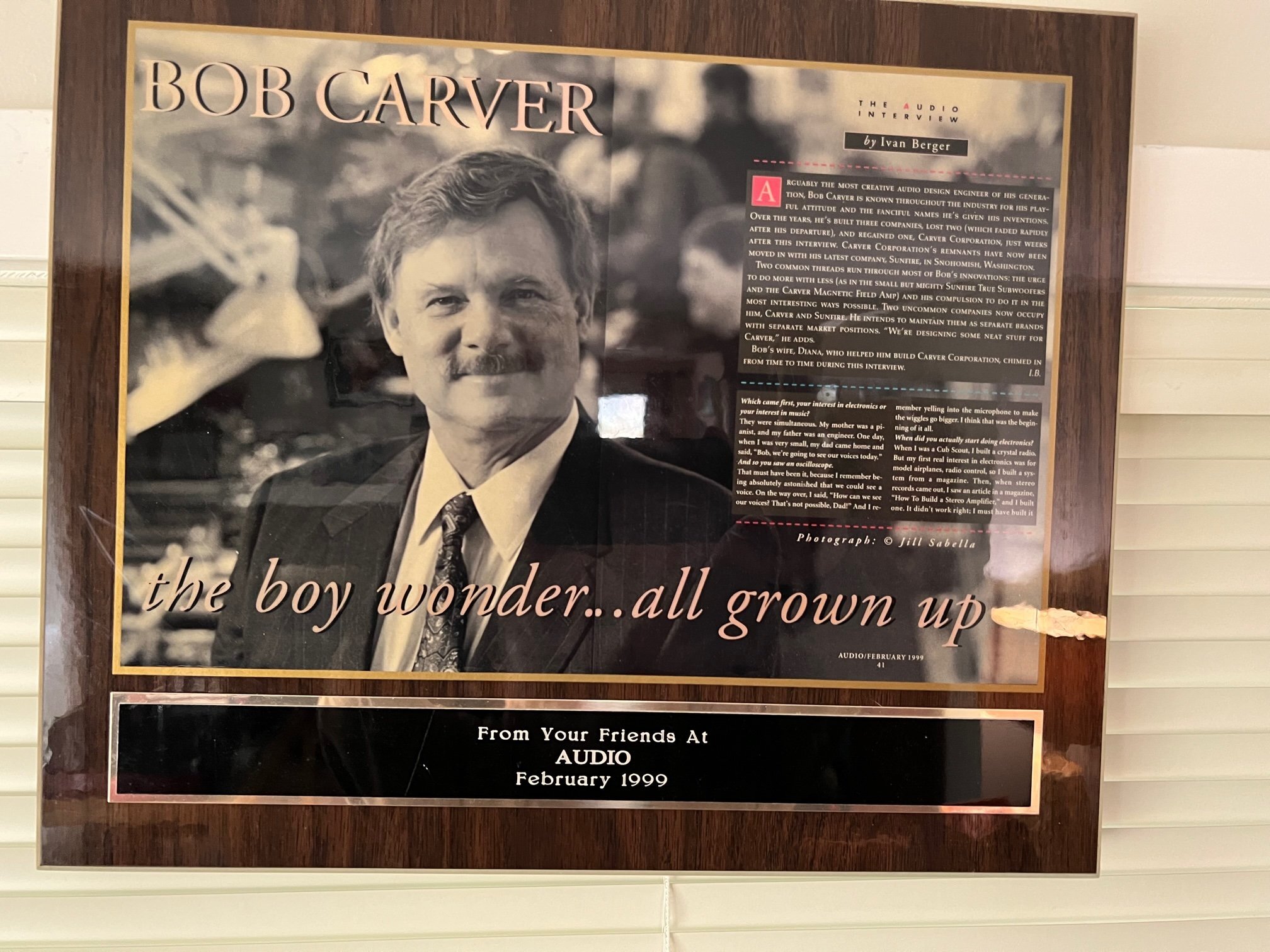
Here is a picture of one of the many awards at Bob's lab.