Ar9Jim
-
Posts
4,108 -
Joined
-
Last visited
-
Days Won
205
Content Type
Forums
Events
Articles
Downloads
Gallery
Store
Everything posted by Ar9Jim
-
Phase Linear has a new noise...
Ar9Jim replied to Lurk's topic in The Welcome Shop (Please read first)
Hi Lurk, Its a tough call. It could be as simple as a bad solder joint. When you restored the unit did you change all of the electrolytic capacitors? Bad solder joints is good first check. Often you can have the unit running on a bench and touch the board with a piece of wood or plastic (I use a chop stick) to see if you can manipulate the noise when near the bad joint. -
Welcome Sir.. Enjoy!
-
Welcome RiversideGuy. Have fun and enjoy. My first system was an M-400 and AR-9s as well. Fun stuff! Great memories!
-
Welcome Dave. Enjoy!
-
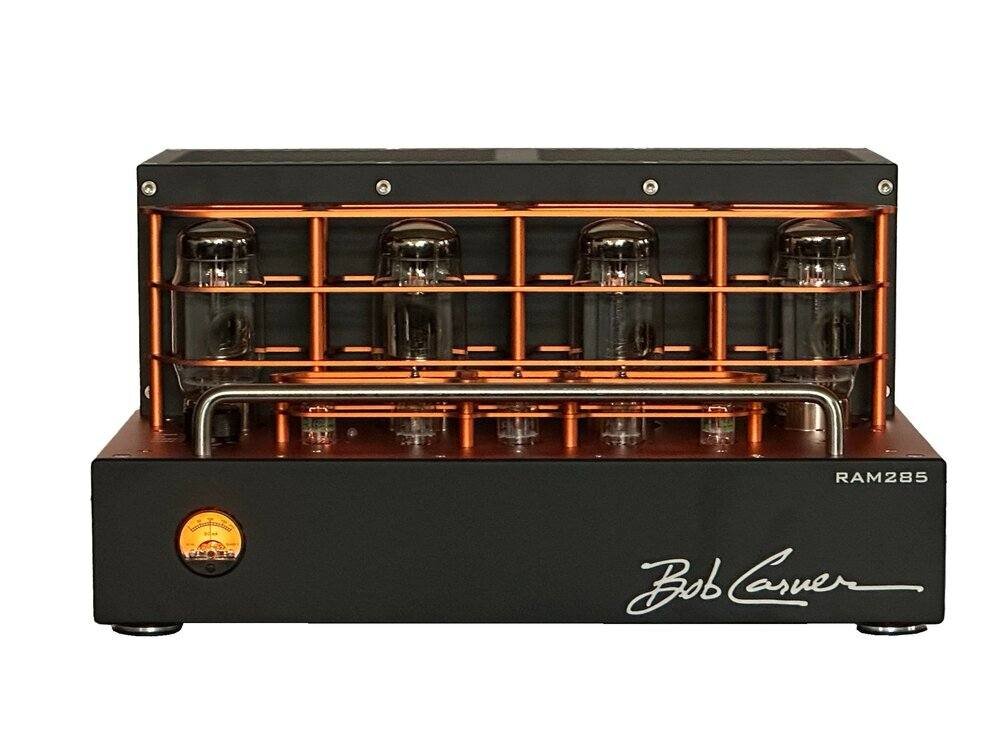
The Black Magic 25 is an EL-34 only amplifier as of Sep 12 2022. The EL-34 is now making its maximum magic..

-
One of the best points in this video is about test gear accuracy and proper applications of the tech.. The old masters have no limits on their access to state of the art test gear, they have that tech as well. Note the distortion analyzers from the 1980s that John is using. Here is one of the same that works well. This one is at the Carver factory in IL. Its one of Bobs. Near the factory, teammate and digital guru, Doug Goldberg has the capacity to test to the extreme precision needed for his DAC development. Doug has been designing digital audio gear, as a hired gun for some of the greatest names in audio, since the birth of digital audio. Doug recently retired as a chief engineer at Lockheed Martin. Bob has the right team in place at every position. Doug can test our products to next level accuracy when required. Older School.

-
Hello Straylight. Viet was around last night. Here is some info.. Bob will be around this morning. Bob can talk at length on these topics. Hope this helps. Hi Jim, Sure I hope I can help but need more background or context. What figure is this referring to and how was the data taken? I am not sure there is much difference between -90 and -72 deg phase for the second harmonic. There is a difference at 180deg though. This is accomplished by flipping phase of the speaker binding posts. That’s different than flipping polarity of the signal before the amp though. This is the difference between positive phase and negative phase second harmonic distortion. I know that Nelson Pass has said that there is positive phase vs negative phase second harmonic distortion and they sound different. Below is from an article that Pass wrote - here is a typical oscilloscope trace of an amp signal in red and the distortion is shown below in blue and here it is dominant second harmonic. The red fundamental goes up and down at a 1kHz rate, and we see that the blue wave goes up and down as well at twice the frequency, but aligned with the red wave in a particular way—the blue goes down when the red goes up and the blue also goes down when the red goes down. I refer to this as negative phase 2nd harmonic. Positive phase 2nd harmonic is the opposite: With positive phase 2nd harmonic, the blue goes up when the red is either up or down. So why is the phase important? Well, it's a subtle thing. I don't suppose everyone can hear it, and fewer particularly care, but from listening tests we learn that there is a tendency to interpret negative phase 2nd as giving a deeper soundstage and improved localization than otherwise. Positive phase seems to put the instruments and vocals closer and a little more in-your-face with enhanced detail. Hope this helps. Viet
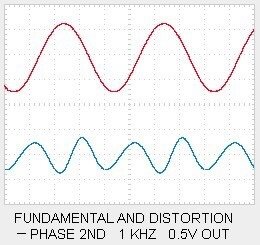
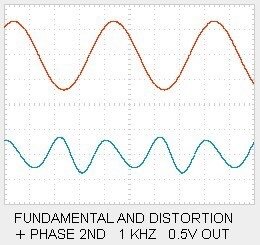
-
Speaking of John Curl.. He has some very interesting views on accuracy for measuring audio products vs measuring accuracy needed for measuring differences in individual component parts. He speaks about designing amps that test great into resistive loads that perform poor running speakers. Things he knows that can't be measured and other things that come with experience. I have heard some of Johns designs taking criticism from the same crowd. He builds what he believes sounds the best. Building something to test good running a resistor is easy. Running loudspeakers well is another goal to a large extent.
-
Hi Jesse, I'll double check. I'm pretty confidant saying the number is exactly the same. The 275 and Black Magic are same board and the 285 is based on the same design. I tried KT120s in the Black Magic. Considerable difference. I like them both. Do you have a preference EL-34 vs KT120 in the Black Magic 25. Like having the extra power supply capacity to play with tubes. KT120s obviously made more power. 6550s can be great in these as well.
-
Sure can. Well, I can't personally, but I'll ask in the morning meeting. Be back shortly. I'm curious as well.
-
Great Conversation, Here is some SIM info on the 285. We also have 3rd party evaluations of products. So far, simulation and bench testing have amazing levels of measurement correlation using these parameters. Note H3 being higher than H2 by design.. Fun stuff. Hugh Dean is a great guy and very brilliant. He is a mentor to one of the PhDs on our team. Mr Viet Nguyen. ANALYSIS LTSPICE OF CARVER BC285 POWER TUBE AMP 6/28/2022 Viet asked me to review the proposed Carver KT120 power tube amplifier, the Crimson, which will be produced for the hifi market. This power amplifier appears to be a conventional, push pull tube style using KT120 pentodes and producing around 80W* into 8R. Here is the basic schematic: I have annotated the voltages and current across the signal chain of this amplifer and redrafted it here for simplicity. It is not as full as the original, production schematic but clarifies analysis. *See postscript for analysis at max power of 125W into 8ohms. GAIN RELATIONSHIPS To begin, we consider the gain relationships at maximum input from 2Vpp to output (secondary transformer, 51Vpp). This is a gain of 25.5 (28.15dB) at 1KHz, which is acceptable in the domestic high fidelity world. It is very close to the THX standard, which is 28.5dB. My initial examination shows interesting gain relationships. Despite using a 12AX7 U1 first stage with mu of 100, the plate current is low at 460uA, low even for a 12AX7, and the stage gives a gain of only 2.1, 6.4dB. Normally with a very high plate impedance of 515k we would expect at least a gain here of 85, so this reduction (no less than 32dB at 1KHz!) reflects heavy feedback to U1 cathode. This high level of feedback, and across the transformer, is combined; voltage from the OPT secondary, and current feedback from R28. This combination of voltage and current feedback on this amplifier is unusual and shows careful manipulation of bass and equalisation which I have seen only on Greek bazouki power amplifiers and, once again, indicates Mr Carver is aware of tube technology all around the world. Since a single pair of pentode KT120 used with constant screen voltage (not ultralinear) delivers high gain but high impedance, this feedback technique can restore superior bass performance but is not well understood. The equalisation on the feedback and grid drives of this amplifier show careful optimisation of stability issues and THD, and this is necessary because the levels of feedback are high for a tube amplifier. The second stage uses a 12AT7 twin triode (mu 50) as a long tailed pair, configured as a phase splitter. The plates are operated at 2.6mA. This stage gives a gain 12.1 [21.7dB] yielding 51Vpp from 2Vpp at input. The plate loads are dissimilar, R13 36k and R14 39k, set to reduce the THD of the amplifier at the speaker. This is conventional, well understood design. By changing one of the resistors (or both) we can set the relationships between even and odd harmonic for this amplifier. HARMONIC PROFILE I have used the operating parameters as follows: ( I omitted the simulation parameters as proprietary, Jim Clark) As mentioned earlier in my first consultation with the preamp, this command set has been used with SS design and uses it to predict sound and electrical performance, in particular the THD and the sum of H2+H3+H4 alone. If H2+H3+H4 is better than 99% of the THD (total) figure and IF THD is less than 0.5%, such a metric indicates very low levels of the objectionable H5, H6 and beyond. This implies that the ear will perceive the sound as ‘natural’. This is based on Jean Hiraga’s work in the sixties in France, and has never failed me. I have set the FFT simulations at +20dBU output, which is 14.14Vp, 28.28Vpp into 8R. This corresponds to 550mVpeak and delivers 12.5W into 8R, about one third the highest power rated for this amplifier. We could expect the results to accord nicely with a listening session in a domestic situation. Here is the FFT at 1KHz 40W into 8R: H2 is at -83dB, H3 is -57dB, H4 is -91dB and H5 is -71dB. THD: 0.168% Second harmonic is at -72 degrees; optimum should be -90 degrees for best depth of image but this figure is very good. By using feedback, THD is low for this tube power amplifier, but at the expense of low EVEN order harmonics. Odd orders are relatively high (typically 25dB higher), reflecting the use of KT120 output pentodes in push pull. Generally with tube amplifiers we try to have higher levels of even orders over odd; this shows many audiophiles prefer a single ended output stage rather than a push pull, but SE is very, very inefficient and leads to much less output power, and high quiescent current, typically 100mA plus. Here is the FFT at 20Hz 40W into 8R: H2 is at -68dB, H3 is -48dB, H4 is -77dB and H5 is -61dB. THD: 0.434% The very low distortion at this very low frequency shows a very linear design, carefully equalised for low bass. This comes back to the current feedback, based around R28. Here is the FFT at 20KHz 40W into 8R: H2 is at -68dB, H3 is -51dB, H4 is -85dB and H5 is -80dB. THD: 0.287% This shows the output at very high frequencies has dropped, from +20dBU to +17.3dBU. This is less than 3dB however, and at 20KHz it is unlikely most listeners would notice, particularly if metal ribbon tweeters are used. THD is excellent at this high frequeny, again due to high feedback. The 1KHz preference of ODDs over EVENs is evidence again, but this is a quality of all push pull amplifiers and yet, because the odds decrease evenly with order anyway, the ear perceives this acceptable although it prefers evens higher than successive odds. It is worth noting that a number of audiophiles actually prefer H3 over H2; Nelson Pass has mentioned this in his writings, so we need to recognise that there will ALWAYS be a market for tube amplifiers, PP and SE. SIMULATION AND INTERPRETATION Between the two opposing audio worlds, subjective audiophiles and technical engineers, there is considerable lattitude to interpret simulation results. At 1kHz, the Carver tube design gives a very high ratio of (H2+H3+H4)/THD of 99.85%. The predominant second harmonic is at -63dB, and H3 a -47dB. At low frequencies, 20Hz, this ratio is 97.36%, with H2 at -63dB and H3 at - 48dB. At 20kHz, the Carver tube design ratio is again at 99.85%, with H2 at -65dB down, and H3 at -52dB. Despite having slightly lower output at 20KHz (down 2.7dB on 1KHz output) the subjective measurements in percentage of (H2+H3+H4)/THD(all) are very high, all over 97.3% for 1KHz and even higher at 20Hz and 20KHz. These point to a very even, highly linear amplifier with excellent levels of feedback control at all frequencies and outputs. Although the Carver tube power amplifier delivers H3 higher than H2, all levels are very low for a tube amplifier with feedback including the output transformer, no mean feat, and it judiciously apportions feedback in two modes to give a very easy, high resolving and non-fatigueing sound. THE TOPOLOGY The Carver topology, like all evolutions, is deceptically simple. First stage as a plate loaded 12AX7 running at very low current (550uA) , low voltage (102V) and a plate load of 515k. The cathode features an unusual complex network accommodating two feedback loops; voltage from the output transformer, and current from a 0.1R sense resistor plumbed into the speaker ground connection. The second stage is a pair of 12AT7 triodes in a long tailed pair, configured to give gain and two anti-phased outputs for the output pentodes. The final stage is a push pull pentode pair of KT120s, transformer loaded and biased at -50V to deliver 30mA quiescent to each tube. With no feedback at all, the gain of the amplifier is 201 (46dB) at 1KHz. With negative voltage gain alone, the gain is reduced drastically to 10 (20dB), giving 26dB of negative feedback at 1KHz and somewhat more and less at other frequencies. With current positive feedback installed, the amplifier has an overall gain of 25.57 (28.1dB), reducing the overall negative feedback from 18dB, about the maximum achieved with a tube power amplifier owing to phase shifts in the output transformer. Manipulating this high level of compound feedback and it with voltage and current drive is an achievement in itself and represents an astonishing level of expertise. Feedback, despite its bad press, is still the dominant technique of refining audio power amplifier design. There are topologies which can be used for PP tube amplifiers. For example, the first stage could use two triode (one bottle) to form an SRPP or a cascade version; the SRPP would not meet gain levels for this circuit, but the cascode would offer a little more feedback but probably tip the amplifier into instability. The phase splitter can be revised, but here is little advantage because the long tail pair in the tube world is ubiquitous for gain, low impedance drive, and moderate requirements of high voltage. The output stage can be reconfigured as ultra-linear, which would add roughly 40% more power output, but the consensus is that the benefit in sound quality is not justified. No, this configuration is a high quality, economy design of very high performance and while I would not design the amp identically, I’m sure I could not improve on the Crimson. POWER SUPPLIES There are five power supplies for this power amplifier. These are; 340V @ 460uA (first stage), 350V @ 1.7mA (pentode outputs screen), 435V @ 5.2mA (phase splitter), 685V @ 64mA (output tubes and transformer) and -47V @ 100uA (pentode output bias voltage). These would not be required regulated, and need not be complex or expensive. Capacitors are always costly for high voltages, but this design would not be more complex than any other design. CONCLUSION The Crimson is an exceptional design; simple in schematic, but complex in its feedback regimes, including negative voltage fb and positive current fb. This is almost never implemented in power tube amplifiers, and the result here should deliver sound quality at very high quality, and yielding very good measured performance as well. The frequency response has been tailored to a flat response, and the output impedance has been optimised for low bass signals. It is very difficult to design good tube amplifiers in AB at high power; 80W* is a medium level and this design is outstanding. Hugh R. Dean.
-
During a recent call with Bob, I mention how low the distortion numbers are on the latest gear, and how well the real world bench test numbers are matching the simulation data. Tube gear in the 1/10 of 1% distortion range, at full power is not that common. Bob made this comment, "I can design tube amplifiers to have distortion numbers comparably low to solid state without a problem." "There is no need to do it, it adds complexity without sonic benefit."
-
Please feel free to repost this on the hack sites. I considered posting this on ASR, but honestly can't give them my single click count. Anything less than a cowardly, submissive response to their totally deceptive, passive aggressive attacks, is said to be a bad attitude and scarlet letter on their latest target. That being said, I have a very bad attitude from their point of view and always will. This is the response Bob wrote for his new website..
-
V2, 8.27.22 Bob Carver Amplifier Design Philosophy — What Sounds Good? Since the early days, after earning my physics degrees, my approach to audio design has created controversy. My unconventional approach has brought both criticism, accolades and world-wide recognition for achieving musical excellence from my wonderful fans. World-wide recognition for offering a more affordable product, compared to most other brands of comparable products. It’s a great pursuit. Myriad technological advances have emerged from someone doing things differently. My amplifiers have often been smaller, lighter, and less costly than others —while remaining powerful, musical, and accurate. These designs and their musical performance are quite successful. I do indeed make comparisons between my design practices and those of other designers. This is done not to foster a “Carver against the world” attitude but rather to highlight significant creative differences. Most other designers have chosen a heavily-trodden path; I simply take a fresh route. What makes an amplifier sound good? Dynamic power, low distortion, and wide frequency response. My tube amplifiers have high voltage (B+); the power supplies are able to “bounce” and increase voltage, closely tracking the musical load with very little distortion. This is an important key to musical performance that cannot be revealed by hooking an amp up to a resistor. Do you design amplifiers using load resistors or speakers? Both. On my bench I start out with resistors, then I use different speakers with a scope and voltmeter connected, while playing music and measuring the amp and speakers reacting together. The back EMF that is present makes speakers slightly easier to drive. Power response, by design, tapers below 80Hz, yet frequency response goes below 20Hz. My designs will drive difficult loudspeaker loads, playing music far better than the specifications listed, without clipping, and with lots of headroom available. These long held design targets have served Carver well. The designs have delivered excellent performing, highly musical products that more people could afford, without sacrificing the powerful and musical performance desired when powering loudspeakers. Stay tuned for more of my very latest designs and the on-line store coming soon.
-
This is from a conversation with my boss, Bob Carver. This was in reference to some internet posting of load resistor test being critical of our specifications, and why their measurements have little relevance describing the designs ability to produce world class sonics, while driving even difficult loudspeaker loads. Please feel free to copy and paste. A more in-depth version will be added to the new web site for all visitors to read. Jim Clark Director of Operations Bob Carver Company Bob Carver Amplifier Design Philosophy - What Sounds Good? Since the early days, after earning my physics degrees, my approach to audio design has created controversy. My unconventional approach has brought both criticism and accolades. World wide recognition for achieving musical excellence for my wonderful fans, while offering a more affordable product, compared to most other brands of comparable products, is a great pursuit. My amplifiers have often been smaller, lighter and less costly than others, while remaining powerful, musical, and accurate. These designs and their musical performance, compared to others are quite successful. What Makes An Amplifier Sound good? Dynamic power, low distortion and wide frequency response. My tube amplifiers have high voltage (B+) and the power supplies have ability to ‘bounce' and increase voltage, closely tracking the musical load with very little distortion. This is an important key to a musical performance. Do You Design Amplifiers Using Load Resistors or Speakers? Both. On my bench I start out with resistors, then I use different speakers, with a scope and voltmeter connected, while playing music and measuring the amp and speakers reacting together. The back EMF that is present makes speakers slightly easier to drive. Power response, by design, tapers below 80Hz, yet frequency response goes below 20Hz. My designs will drive difficult loudspeaker loads, playing music far better than the specifications listed, without clipping, and with lots of headroom available. These long held design targets have served the industry well. The designs have delivered excellent performing, highly musical products that more people could afford, without sacrificing the powerful and musical performance when powering loudspeakers. Stay tuned for more of my very latest designs and the on-line store coming soon. Bye for now, Bob
-
Bob Carver - The Maverick
Ar9Jim replied to Ar9Jim's topic in Bob Carver Corp CLOSED - Archive only's Jim's Blog
Bobs wife Peggy has has accumulated lots of history. I will continue record conversations with Bob often, for the historical reference. Peggy assembled an audio history based book (shown here). She is cautious to release it, due to other companies mentioned, until sure there are no copyright issues. The audio history of Bob is only 1/2 the story, the man himself is just as interesting. The personal stories from his childhood forward need to be recorded. His going to school in Germany as a child and speaking German, while his parental father, Tom Carver, was an attorney working on the Nuremberg Trails of Nazi war criminals after WWII and much more. Just an amazing life that reads like a Hollywood movie..Here is a picture of the book Peggy wrote. It is on display at the Illinois factory.
- 17 replies
-
- 11
-

-

-

-
Bob Carver - The Maverick
Ar9Jim replied to Ar9Jim's topic in Bob Carver Corp CLOSED - Archive only's Jim's Blog
Here is a some info that will be posted on the new website and store. Bob wrote this today. The web designer, Ron K, will put his touches on it. Ron is the same guy that has worked with Bob for decades and did the Carver ads back in the 1980s. I'll post the final version in a separate post when its finished. Bob Carver Amplifier Design Philosophy - What Sounds Good? Since the early days, after earning my physics degrees, my approach to audio design has created controversy. My unconventional approach has brought both criticism and accolades. World wide recognition for achieving musical excellence for my wonderful fans, while offering a more affordable product, compared to most other brands of comparable products, is a great pursuit. My amplifiers have often been smaller, lighter and less costly than others, while remaining powerful, musical, and accurate. These designs and their musical performance, compared to others are quite successful. What Makes An Amplifier Sound good? Dynamic power, low distortion and wide frequency response. My tube amplifiers have high voltage (B+) and the power supplies have ability to ‘bounce' and increase voltage, closely tracking the musical load with very little distortion.This is an important key to a musical performance. Do You Design Amplifiers Using Load Resistors or Speakers? Both. On my bench I start out with resistors, then I use different speakers, with a scope and voltmeter connected, while playing music and measuring the amp and speakers reacting together. The back EMF that is present makes speakers slightly easier to drive. Power response, by design, tapers below 80Hz, yet frequency response goes below 20Hz. My designs will drive difficult loudspeaker loads, playing music far better than the specifications listed, without clipping, and with lots of headroom available. These long held design targets have served the industry well. The designs have delivered excellent performing, highly musical products that more people could afford, without sacrificing the powerful and musical performance when powering loudspeakers. Stay tuned for more of my very latest designs and the on-line store coming soon.- 17 replies
-
- 15
-
-
-
-
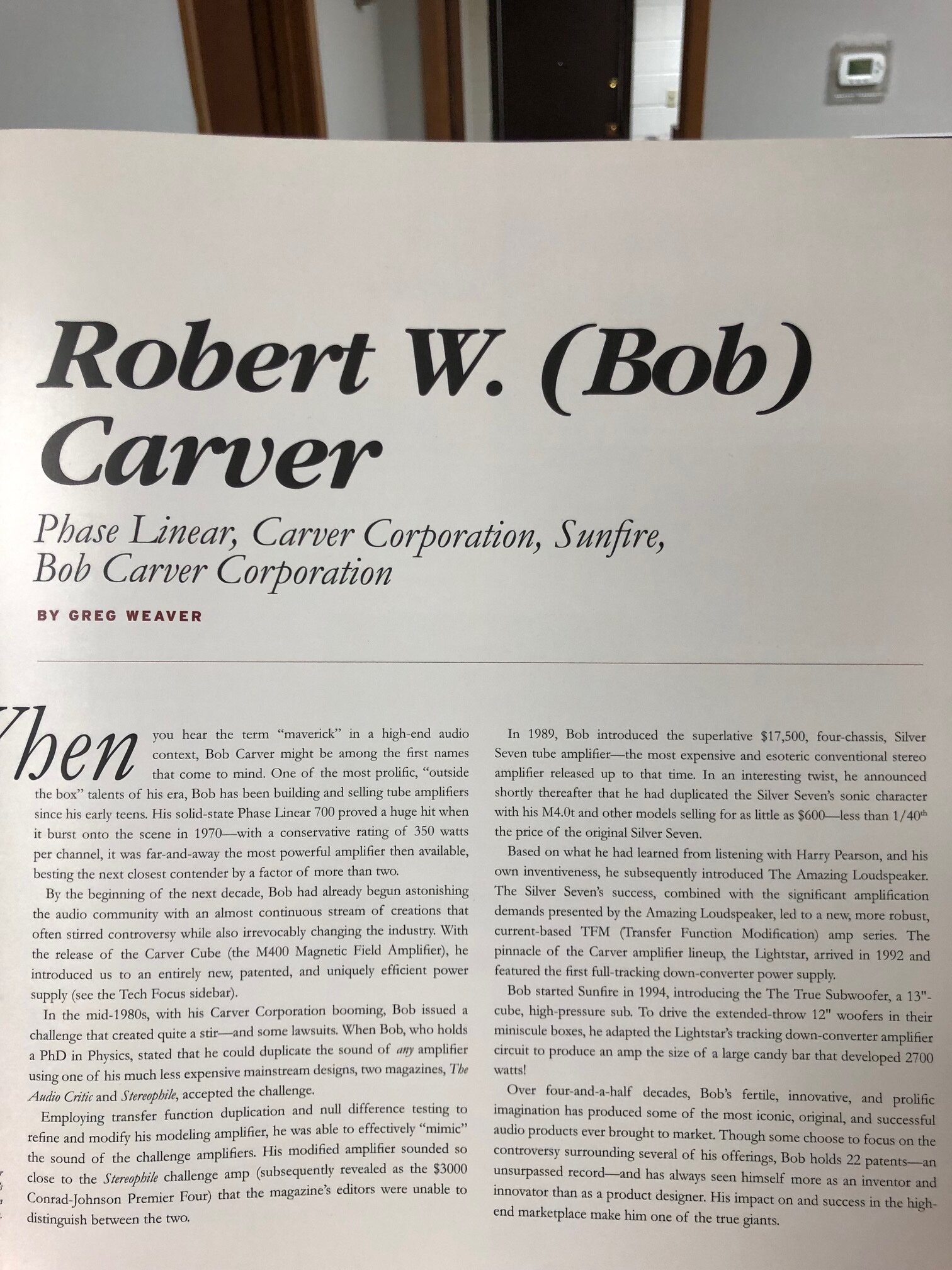
This is the first page of the Bob Carver chapter from the book shown. The topic of controversy came up when having our morning meeting with Bob. I mentioned to Bob that I could care less what the on-line hacks think of me, but it can get under my skin when I feel Bobs work is being unfairly represented. Bob reminded me, that he has been under attack his entire career and he gave great advice, as he always does. I happened to re-read this article. It reminded me just how long Bob has been designing and how long critics have been there. Bob has never followed the crowd. He is a true maverick.



-
The new products will conform to CE, and built to aerospace standards like those of my last aerospace manufacturing company, that we sold after 20 years to another company that moved it. Going forward. Hacks will always be there, always have been there, even in the 1970s.. Flame Linear? How is hind sight on that one? One suggested that I have poor credibility due to the 275. Most of the commercial aircraft and a large part of the military uses components made at my former company. They may seriously want to consider my credibility next time the fly on an aircraft. With GE, Boeing, Airbus, Lockheed, my credibility is just fine. On-line hacks, I don't care about. For anyone is interested in the quality system model being used by our team, more can be read here. https://en.wikipedia.org/wiki/AS9100

-
I stand by the fact that the latest hack by the same guy is garbage. I know I seem defensive to the latest hack. I am. The claims are irresponsible and lies, simple as that. The factory test those at at least 357 watts RMS into 8 ohms. People say what ever they want. Look at politics. I really don't care what the hacks say, and it drives them a bit nuts and thats just fine. They act as though companies are supposed to be submissive to their attacks or you have a bad attitude. Its cool. I do have a bad attitude towards hacks. I'm not lying to anybody to stroke their ego's. The new products will be the best Bob has ever made. Will they attack those to? Oh god yes. It never ends. Its what they do. It gets clicks.
-
I would suggest that an 8 ohm resistor running sine waves, and an 8 ohm speaker running music are not the same. I would rather listen to the design for dealing with dynamic speaker loads, than a steady resistor, 9 times out of 10.
-
Just pointing out that these products are not designed to be the best at running resistors, but running loudspeakers, playing music. It seems to be widely assumed that all specs are quantified running a 8 or 4 ohm resistor, rather than 4 or 8 ohm nominal loudspeakers, having a widely varying impedance. Designing to be musical driving speaker load requirements makes more sense to me, but thats a personal choice. You can find amps that test great at running resistors, that sound like crap running speakers when making music. No victim here, other than people that buy based on resistor test, without hearing the musical performance running speakers.
-
Thanks for sharing your thoughts guys. People that actually drive loudspeakers with our products and talk about it on-line is important. The resistor running crowd has been on quite a mission to discredit the great designers of the industry, with resistor running contest. I try not to bother Bob with this internet 'stuff'. He has never played by anyones rules and has generated controversy all his life. I'm here to take some load off, and let him practice his beloved craft of designing great sounding gear at decent prices for everyones benefit. He has a gift. Do I want to disturb him from what he loves, to respond to critiques at 80 year old? I can't do it. His time is more precious than any damage these hacks can do to his reputation. Every minute I get to spend talking with Bob is golden. I'm not going into the internet BS with Bob, as much as these people would like to distract us from our mission with their attacks. Let Bob play and enjoy being in the zone. We will all hear the results. When the 275 attacks started, I got Bob involved and he responded with a true statement about Amirs test not representing the sound engineering and design of the amplifier, and that he stood by his product by offering returns if someone didn't like the sound of his amplifier. We let that run for over 30 days. We had a handful of returns. Of those returns, the majority later expressed regret, when trying competing products in the price range. Did the ASR review serve the consumer well? No. Did it damage our 275 sales, Yes it did. Bob made some comments to me at that time. 1. When talking about load resister test Bob said, "I haven't designed amplifiers that way in over 20-25 years". Harry Pearson started that in his magazine the Absolute Sound long, long ago". 2. "Designing amplifiers to run resistors, and designing amplifiers to sound good, are not necessarily the same goal". Jordon Gerber, a young physicist that worked with Bob, once told me, "Jim, they don't know what makes an amp sound good". I get phone calls from people telling stories about Bob helping them with their projects every week. Its amazing how much time Bob has taken to help people with their projects. He use to spend huge amounts of time helping people, judging from the volume of calls I get, asking "how is Bob"? "Bob helped me with my- (fill in the blank). Its hard for me to believe , honestly. Just yesterday a gentleman called me in reference to the latest on-line hack. "Jim, when Bob helped me build my amps, he was running speakers with them, and had test equipment measuring the dynamics and what was actually going on driving speakers, not resistors". Found that interesting. I will ask Bob about this.
-
We will with new products. Its a standard procedure to document the inspection results by s/n and keep them on record. The 350s are each tested in California and signed inside by the builder. People on-line can still say anything they want, for any motive they have. ASR can test a vintage M1.5 and say it doesn't meet specs as though it never did, and claim a gotcha and some sort of moral authority to judge, based on a disclaimer of "I just test what people send me." Same as the latest bozo. Good for the hobby? I don't think so, imho.. Science with no control of the sample? Is there is such a thing?
-
Working for Bob is great. Dealing with clowns on the internet is not. As you may have noticed, most of the legendary designers in this industry have been under attack in the measurement based forums. Bascom King, John Curl, Bob Carver and others.. The measurement site boys try and play gotcha somehow, as if everyone is a liar but them, claiming some sort of holy than thou mind game, with their groupies on their heels. The latest is a guy who works for Bottlehead Amps who makes $2000 kit amps that make 8 watts, posting on a site that our 350 watt amps make 8 watts at 1Kh.. That company has a disclaimer saying, since it is a kit, they are not responsible for their 8 watt claim or the amps performance. Needless to say, I was little irritated that someone would get measurements so far from actual, and actually post this deception on-line. Anyone can say anything they want to damage a company. Then others on-line expect companies to waste time and resources responding to their post. To me, saying an amp that makes 357 watts RMS at 1k and saying it makes 8 watts is basically a liar. His groupies say my character is questionable due to the 275 and those issues. They believe his results and don't understand my being defensive. It's all good. I'll avoid those forums. People can claim whatever they want, with products of unknown condition that are sent in off the street, and attack companies. Unfortunately people read their garbage. Like in the latest attack from a bozo who works for another tube amp company. Nice. Lets all play the same game, and cut each others throats, shale we? How's the hobby then? Everyone can listen to a Topping because it measures best on ASR.. I probably shouldn't post while angry, but after a couple days of it, I need to vent.. Life is too short to chase jerks around the internet ,and act subservient to their BS and judgement of my attitude.. Their damn right I got an attitude. We are building the best Carver products possible from excellent designs that Bob has created. We are a start-up, of a handful of people working hard to get the legacy right. When you are Bob Carver, the little tiny men will take cheap shots at the biggest guy in the room. Bobs told me "this is just someone trying to make a name for themselves, taking shots at Bob Carver, Its been this way all my life." After finding out this bozo works for a tube amp company, his motive is clear and Bob was 100% correct. If someone wants to buy a Carver, they can try it in their system at home, risk free, against the competition for a month. This the most honest way in the world to sell equipment and stay above this internet full of trash posting people, acting as if they are righteous and helping the consumer. Americans are missing out on some great products. Look at the Munich hi fi show. I have asked company reps, why don't you sell in the USA? Answer: They sue too much.. Pass Labs sells the majority of their products outside the USA.. All new Bob Carver products will meet CE and world standards for export. There is a reason Bob Carver is world famous and the hacks are, who? People with fake names hiding behind their computer, throwing stones at the legends of the hobby to pump their fragile ego.. Sign of the times I suppose. If an amp company won't let you try the product, without a restock fee, that should tell people more than any internet hacks review. Keep it Fun. Enjoy the music! Jim Clark
- 23 replies
-
- 15
-
-
-