


Nahash5150
-
Posts
8,032 -
Joined
-
Last visited
-
Days Won
389
Content Type
Forums
Events
Articles
Downloads
Gallery
Store
Everything posted by Nahash5150
-
-

Oldphaser (First Post)
Nahash5150 replied to oldphaser's topic in The Welcome Shop (Please read first)
@oldphaser Welcome Ed! So what brings you here? -
@BrianD Yes, we can fix them. Link to your thread?
-
-
What Measurements can we hear? Can we measure sound quality?
Nahash5150 replied to Ar9Jim's topic in Media
Almost, but not yet. The conclusion is you can't measure sound quality. However, you can measure, and predict, sound fidelity. Sound 'quality' is subjective. Sound fidelity is objective. Both fidelity and quality are attributes that power amps exhibit with various degrees at the same time. So...which amps 'sound the best'? We're just deep in the weeds about what amps are predictably faithful, and what topologies are known to have good qualities... -
What Measurements can we hear? Can we measure sound quality?
Nahash5150 replied to Ar9Jim's topic in Media
I think we're mixing practical application with theory...such is to be expected in a discussion like this. Voltage amplifiers are very successful, there is no question. But to say that pure voltage source is ideal for a loudspeaker, or even better than tube amps in general, is a theoretical stretch. The tube amp design has characteristics that are difficult to duplicate with solid state and vice versa, however, good design can bridge the two, and that is really the focus of my thought in all this. Designing a system to faithfully drive the total mess loudspeakers are, is an incredible challenge. It's one thing to test into dummy loads - quiet another when driving transducers. Subwoofers benefit greatly from low output impedance, largely due to their back EMF which can not only wreck havoc on an output stage, but also ring and distort against a higher output impendance. Large voice coils require an immense amount of total energy, especially in light of the fact that they are very inefficient for a transducer. Solid state is the way to go, but the amp must be formidable with and output stage ready to take on a beating. Don't get me wrong, I love solid state amplifiers. However, when I listen to many non-Carver amps I feel something is always missing...the mid range and top end can get so smeared and tiring. Tube amps just don't ever tend to sound quite like that. And that's what got me thinking... Nah - all you need are good transfer function generators on your SS tower of glory. That's a good distillation of my thought process. Solid state amps get very complicated, and it is all due to the problem of efficiency and maintaining fidelity over a wide range of load parameters ( I often tell people 10% of the amp does amp stuff, the other 90% of the components are there to make sure the 10% behave). Negative feedback has its limits, and loudspeakers can bully it substantially. Moreover, transistor output impedance, even with negative feedback, modulates with the frequency (think transient response and IMD) - it's just not a good relationship. Even good design makes compromises here. However, as Bob discovered, using current and voltage feedback, you suddenly peek into a transconductance amplifier, which is the true ideal to strive for. Obviously, there are many designs that work very well - no reason to bring all the products up here though. The elephant in the room is that voice coils are a current controlled device...and so voltage sources become challenged by the laws of physics, which care not of our feelings. ? -
What Measurements can we hear? Can we measure sound quality?
Nahash5150 replied to Ar9Jim's topic in Media
Agreed. However, pure voltage sources are not a knock-down drag-out solution to the loudspeaker. There is no prevailing opinion or evidence that I am aware of to suggest that such a design is practically obtainable (not to say that brilliant things can not be done with transistors and feedback...but to say black and white, ideal voltage is the answer is not a design undertaking I'd shoot for). Voltage source amplifiers have a long history of problems (hear hear Douglas Self). Requiring 20kw of power for blissful listening experience is only in support of my point - you could do the same with 20watts of tube amps. Kidding... -
What Measurements can we hear? Can we measure sound quality?
Nahash5150 replied to Ar9Jim's topic in Media
My point was not that tube amps are superior, because we all know that tube amps as a design have a lot of flaws. However, that does not mean they don't have good/useful characteristics. -
What Measurements can we hear? Can we measure sound quality?
Nahash5150 replied to Ar9Jim's topic in Media
Apples and oranges here... Voltage sources in practice struggle with low impedance precisely because of the current demand. This is why coupling devices with voltage sources like to see a high impedance (x10 ideally) so as to not cause distortion due to the voltage divider effect, as well as wasted heat, caused by undue current drain. Low impedance speakers tend to kill transistor amplifiers - this isn't my idea, it's a fact in all of the audio world. Tube amplifiers, because of their high output impedance, and thus, more virtual current sourcing ability, tend to not mind low impedance loads. Again, this is well known. High sensitivity speakers, for example, tend to be a very difficult, near short loads, and very often require a coupling transformer in typologies such as PA systems and live concerts when driven by transistor amplifiers. Voltage source amplifiers rated down to 2 ohm continuous are quite rare. However, quite common for classic tube amplifiers. My response was to your initial comment: That's actually not true. One of the benefits of high output impedance is indeed useful for tracking a varying load impedance. This is why differential amplifiers benefit from current sourced tail current - they are close to immune to the varying changes in the transistors' internal impedances and load current. Current sources are used primary in all of electronics for precisely the problem of varying load impedances, especially non-linear impedances and high frequency impedance changes (like noise). An op-amp is as close to an ideal voltage source amplifer that we have. However, they have severe current sourcing limitations due to power consumption - often no more than a few milli-amps. It's relatively easy, thanks to physics, to create a voltage. Not so easy to source current though (think alkaline batteries and such). Voltage sources are simply not known to be stable into low impedance. A great amount of materials and components and design needs to be employed to reach a near ideal voltage source for high power applications. In fact, it's the challenge of all challenges when designing an amplifier (think mag coils, tracking downconverter, class D, etc). Feedback is necessary for linear output in a mulitport, multistage system. Has nothing to do with DC supply regulation, unless you're talking about power supply feedback, which should not be confused with signal feedback. I beg to differ. @RichP714 posted an article on transconductance that should help. I talk to Bob about this all the time. Pure voltage source amplifiers need to be extremely expensive to handle a loudspeaker load at high power. They are wildly inefficient as well (total waste of power). The mag coil power supply design as well as current feedback transfer function design aid a voltage source amplifier with incredible results. It's no mistake that these designs imitate some of the virtues of tube amplifier driving characteristics, especially their higher output impedance. Suffice to say, a high power voltage source amplifier requires an immense, wasteful power supply to remain linear, and that is after we get over the many shortcomings of emitter followers driving a very complex reactive load. "Driving your car with chopsticks" is such a good analogy. -
*SOLD* Carver m1.0t mkII opt002 $750
Nahash5150 commented on Nahash5150's gallery album in SOLD archive
 Good question! I never used the power supply PCB's made by others - I've always used a plexiglass platform to secure the HR caps. This was a modification of Rich's mounts, which kept the components up and away from the main PCB. So my previous work is still 'compliant' in that respect. Everything else I have done also followed the proper guidelines, which has always been in favor of the amp's performance, rather than how it looks. As far as updating my previous work - there's no immediate need to do so. I still fully support the work I've done, but I can't realistically accept a never-ending 'service loop' as my technology gets better. In any case, amps sent to me for updates will be charged minimally.
 -
-
*SOLD* Carver m1.0t mkII opt002 $750
Nahash5150 commented on Nahash5150's gallery album in SOLD archive
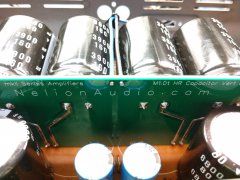
@Sk1Bum I'm glad you asked. There are a few... 1) It permits easier serviceability of the PCB. No components are permanently covered like other retrofits available. 2) Its massive ground plane keeps the amp quiet. 3) Has much more substantial traces than other retrofits to connect the pos and neg High Rail voltages to each channel, eliminating the 20ga blue and red wires. 4) It's much better at allowing heat to escape the PCB rather than suffocating it like other retrofits. 5) It is cheaper and faster to install than other retrofits.- 9 comments
-
- 12
-

-

-

-
-
Not common sense compatible
Nahash5150 replied to RichP714's topic in The Outer Rim's Outer Rim Topics
@RichP714 I personally never claimed the universe was flat, nor did I claim it was curved - I merely communicated what the prevailing theory is and how physicists themselves explain it. I used the age scale, you are using the euclidean distance scale. Again it's not my logic here...the point is if it is curved it is huganomious! For practical purposes, it is believed to be flat. If it is not flat, then it is much, much bigger than we expect. By scalar comparison, a black hole is infinitesimal compared to space-time. There's no meaningful ratio between the two, in fact. That is not to say the phenomenon of space-time can't be explored more dramatically by observing and thinking about black holes, only that by order of actual scale, their disturbances are not expected to influence the curvature of space-time, no more than Mount Everest defines the shape of the Earth, even though one could fall to their death from its summit. About the video... Yeah, I read Machio Kaku's 4th Dimension too, and Flatland. It's rather pointless to get that deep here... -
*SOLD* Carver m1.0t mkII opt002 $750
Images added to a gallery album owned by Nahash5150 in SOLD archive
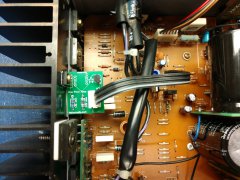
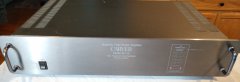
The tremendous power and sonic performance of the M1.0t mkII opt002 is spiced up with Nelion Audio's new retrofit kits. Featuring the vertical high rail capacitor board, and new bias pivot and thump fix CCA's, the mkII feels and looks more professional than ever. Comes with 3 year parts and labor warranty. $750 Feel free to comment below or contact me via PM for questions. Thanks for looking!- 9 comments
-
- 12
-
-
-
-
-
From the album: *SOLD* Carver m1.0t mkII opt002 $750
-

From the album: *SOLD* Carver m1.0t mkII opt002 $750
-
From the album: *SOLD* Carver m1.0t mkII opt002 $750
-
From the album: *SOLD* Carver m1.0t mkII opt002 $750
-
From the album: *SOLD* Carver m1.0t mkII opt002 $750
-

From the album: *SOLD* Carver m1.0t mkII opt002 $750
-
It's an arbitrary time limit. Was set to 60 minutes, I have just adjusted it to 10 minutes. I hope that helps. As long as the flood control is not abused, we can keep it low.
- 1 reply
-
- 2
-
-
Dream Theater fans? Check this out...
-
Not common sense compatible
Nahash5150 replied to RichP714's topic in The Outer Rim's Outer Rim Topics
Yes, but the local distortions are tragically small compared to the whole, not unlike hills and valleys on the surface of the earth, although far smaller a ratio by comparison. It's flat as far as we know, because if it is curved, then the universe would be much larger than we can see, and I don't think anyone has discounted that. For all practical purposes, the observable universe is flat, and that's 13.8 billion light years in every direction. Distortion everywhere indeed. The universe has a tube transfer function. -
Long ago, scientists (we call them philosophers now) defined matter as 'that which contains parts'. Searching for 'fundamental matter' is rather futile. No matter how small or elusive, we won't be able to find anything that is its own cause. I get that they are trying to understand Quantum Mechanics and Gravity, but the speculations get tiresome.
-
Not common sense compatible
Nahash5150 replied to RichP714's topic in The Outer Rim's Outer Rim Topics
@Sk1Bum I remember studying physics when I was in grade school and the notion of the curvature of space was always elusive. My tutors, like Isaac Asimov, tried to explain it but it didn't make much sense because we can't visualize it in 3+1 dimensions. However, we can abstract it in 3 dimensions like the surface of sphere. For instance, we know that the earth is a sphere because if we are at sea, land masses appear and disappear out of view. This indicated that our location relative to another object is subject to a curvature that causes it to become invisible because we can't see though the water or earth. With Space, it is the same idea. However, space appears flat because we can see objects, and energy, all the way back before there were stars. In fact, we can still see the first light, often called the 'Cosmic Background Radiation'. Essentially, if space was curved, we'd expect a horizon beyond which we cannot see. We'd see only signatures, or maybe reflections of objects, but not the objects themselves. The 'flatness' of space reveals that our relative locations, on a grand scale, experiences little distortion across billions of light years of distance and time, even all the way back before galaxies and stars existed. -
?