

oldtexasdog
-
Posts
4,579 -
Joined
-
Last visited
-
Days Won
30
Content Type
Forums
Events
Articles
Downloads
Gallery
Store
Everything posted by oldtexasdog
-
Nice! Welcome to the sight Dave.
-
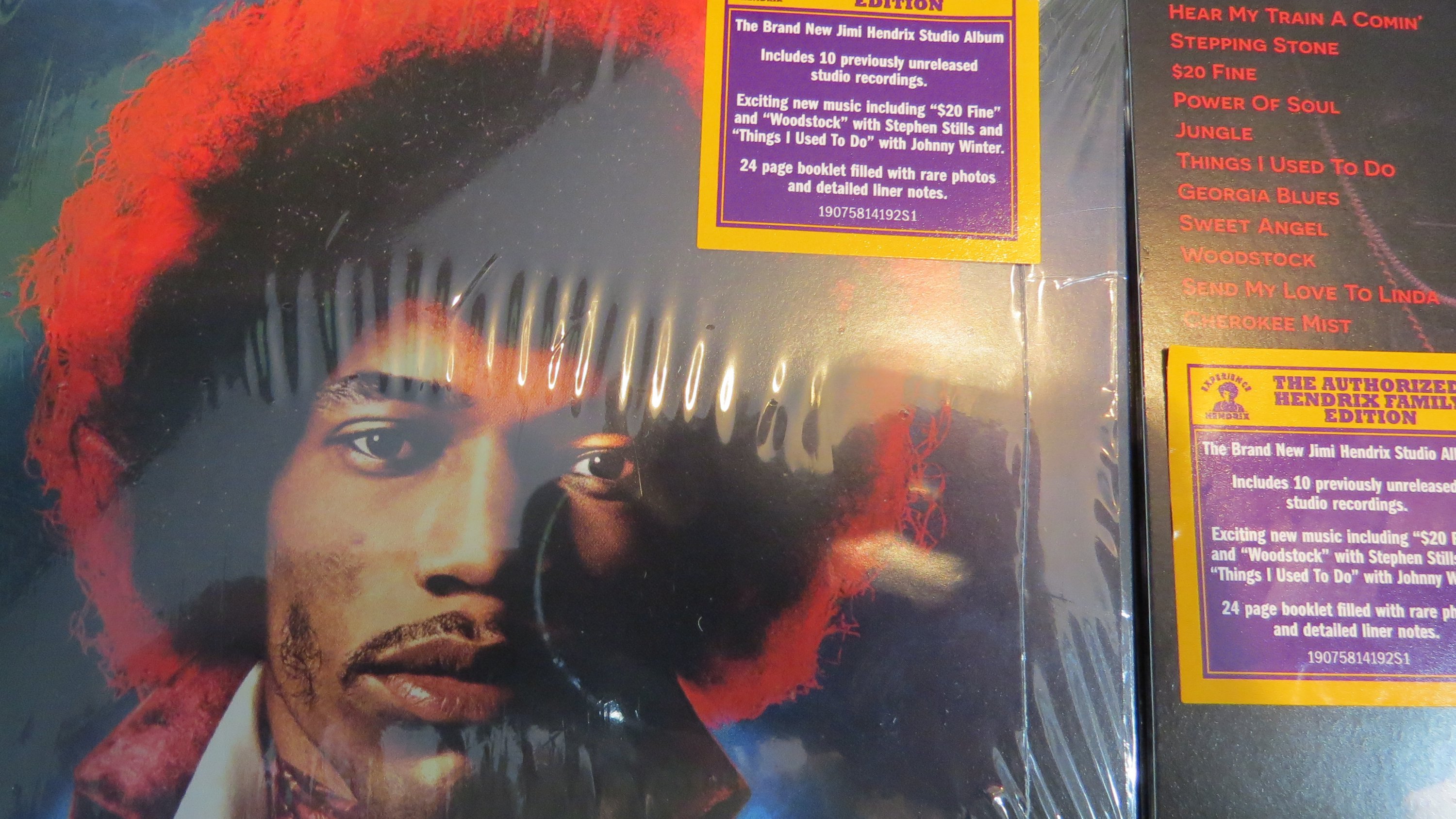
New release studio Jimmie Hendrix Both sides of the Sky. Is it the best Hendrix release-no Is it good- Yes! Family put it out. Seems Jimmie liked to invite a few friends (John Crosby, Stephen Stills.Nash and young,Johnny Winter, Duane Hitchings, Dallas Taylor, Lonnie Youngblood, and others over to his new studio to jam after a night out. It's raw but complete.

-

Quad ESL 57… Brooklyn, New York to Northern California
oldtexasdog replied to wdc's topic in Loudspeakers
P;ace them on either side of the fireplace--Cowboy AUX HEATERS They sounded fantastic at CF17 off Carver Sunfire amp I believe. -
-
In-A-Gadda-Da-Vida LP in pristine condition I found today for 5.00 As a matter of fact I found 5 LP albums today all Pristine for a total of 27.00 In-A-Gadda-Da-Vida-Atlantic Crosby,Stills,Nash& Young 4 Way Street double album-Atlantic Fabulous Thunderbirds-Tuff Enuff-CBS The Moody Blues-Seventh Sojourn-London Records Bill Black Combo Goes WEST-Royal Recording Studio Little Antique shop off of 114 5 miles from the house.
-
New Audio addition to the family Quad ESL 57’s.
oldtexasdog replied to wdc's topic in Loudspeaker repair
I believe sea had a pair of those at CF17 and they just blew me away!!! And I am a B&W lover!! Are you sending them to Sheldon Stokes? I believe sea said that's who redid his and he said Sheldon specializes in the Quad ESL's Congrats on acquiring some great ones! -
Welcome Kevin-looking froward to your post!
-
Howdy, new member, long time Carver owner!
oldtexasdog replied to nettlecreek's topic in The Welcome Shop (Please read first)
Welcome! Look forward to your post! -
Welcome
-
Outstanding Z. My new near field speakers and my ears love it!
-
Nuts, can't get it to play?
-
Comparing system changes. Whats your favorite music test tracks.
oldtexasdog replied to Ar9Jim's topic in Media
Days of the New. Great seperation and placement. -
Are Carver Pre-Amps worth purchasing
oldtexasdog replied to 19Joey81's topic in The Welcome Shop (Please read first)
Welcome Joey81!! The C1 in a modest or even a high end system with the BillD mods is hard to beat without spending 1500 & and more GBP. What part of Scotland do you hale from? I had a house in Dunoon on Milton for about 20 years. In any case sit back enjoy the company-glad to have you aboard. -
I almost exclusive buy their high end pressings Quality Record Pressings Audiophiles remember and still covet the UHQR pressings from JVC Japan from some 30 years ago. They were the pinnacle of high-quality vinyl, and UHQRs remain among the very most collectible and valuable LPs ever pressed. Now, Quality Record Pressings is reviving that long-gone name of excellence and adding to it an even higher standard of perfection. With the UHQR from QRP, we've applied all of the most innovative and ear-approved ideas ever introduced to vinyl LP manufacturing to create an ultimate LP. Never before has one record represented such singular superiority. Each UHQR is pressed, using hand-selected vinyl, on a manual Finebilt press with attention paid to every single detail of every single record. All of the innovations introduced by QRP that have been generating such incredible critical acclaim are applied to each UHQR. The 200-gram records feature the same flat profile that helped to make the original UHQR so desirable. From the lead-in groove to the run-out groove, there is no pitch to the profile, allowing your stylus to play truly perpendicular to the grooves from edge to center. Every UHQR is hand-inspected upon pressing completion, and only the truly flawless are allowed to go to market. Your UHQR will be packaged in a deluxe box and will include a booklet detailing the entire process of making a UHQR along with a hand-signed certificate of inspection. This will be a truly deluxe product. UHQR: Hand selected and hand inspected. Handmade and worth every dollar paid. Clarity Vinyl is the ultimate vinyl formulation because it contains no carbon black additive, common in vinyl formulas for LPs. Carbon black contains trace metals that become magnetized and cause electrical distortions in cartridges during playback. The result is a smearing of the sound. It's the same reason that cartridge demagnetizers are effective. By taking the carbon black out of the vinyl, we are able to dramatically reduce the distortion and thus bring more clarity to the playback process, providing a more realistic musical experience for the listener. Our Clarity Vinyl is also made using the highest quality co-polymer available - a key component in the vinyl pellets used for manufacturing LPs.
-
A week ago, Lady Gaga released her fifth album, "Joanne," which has a stripped-down sound that is quite different from her previous efforts. She has promoted the album with performances at small night clubs and dive bars, a coming home of sorts to the days when a young Stefani Joanne Angelina Germanotta would tear up a West Village bar with nothing but her voice and a piano. Beyond Gaga's performances, what’s unique about "Joanne" is how some of the songs were made. When she announced earlier this year that she was recording an album with the producer Mark Ronson, the press began calling it her analog album. What’s an analog album? Since the late nineteen-nineties, when Pro Tools recording software became widely accepted, the vast majority of music has been recorded digitally onto computer hard drives. The advantages of digital recording are obvious: Pro Tools allows for endless editing and manipulation of sound, from pitch-correcting vocals to splicing up ten takes of a song into one seamless track. Cheaper versions of the software let amateurs record in their homes, which makes music accessible to many more people. Pro Tools also helped create new genres, like modern electronic dance music, mashups, or the stripped backbeat that powers much of today’s hip-hop, by artists like Drake. Analog preceded this. It is music recorded on reel-to-reel tape machines. The only way to edit tape is by slicing it with a razor and attaching it to another piece of the tape, an irreversible process that restricts after-the-fact manipulation. Despite these limitations, over the past several years, a number of musicians, from well-known pop stars to young independents, have begun seeking out studios, producers, and engineers who have the skills to record albums with the tools of the pre-digital era. Early advocates included Gillian Welch and the Foo Fighters (whose 2012 Grammy-winning album, "Wasting Light," was recorded on vintage equipment in the lead singer Dave Grohl’s garage), as well as analog’s high priest, Jack White, whose Third Man Records not only produces albums in White’s analog studio but regularly records concerts live to vinyl masters, which they press and distribute. This return to analog (which mirrors the revival of vinyl records) may have begun with rock and indie albums, but it is increasingly found across genres. Recent analog albums include work by the neo-soul star D’Angelo, the Wu-Tang veteran Ghostface Killah, Ryan Adams, the Black Keys, and Arcade Fire. "Joanne" is not completely analog, but “at least three songs were recorded to tape,” according to Mark Ronson’s manager. The reasons that musicians record on outdated, archaic, and less flexible equipment are, in some sense, surprising. The assumption is that they want to capture a certain audible sound quality—the oft-mentioned warmth of a tape recording. This is a factor, but is not as significant as people tend to assume. Today’s professional digital recordings offer a sonic quality that only the most discerning audiophiles can distinguish from its analog equivalent, and today most people consume music through tiny headphones, regardless of how the album was originally recorded. “I think the sound quality is one of the smaller reasons why people chose analog,” Chris Mara, who owns a Nashville analog recording studio called Welcome to 1979, said. Mara, an experienced recording engineer, opened the studio eight years ago in a former record-pressing plant, and his business had doubled pretty much every year since. The bands and musicians who seek him out—as well as a growing cluster of other producers who have sprung up around Nashville—tend to be younger and are looking back in time to get away from the heavily manipulated, overly polished sonic atmosphere of modern pop. These musicians want their albums to sound like those made by Led Zeppelin, Sam Cooke, and Bruce Springsteen—not Justin Bieber. By recording like the legends of the twentieth century, they hope to create something new. Another analog studio engineer in Nashville summed it up in simpler terms: “The old shit’s the best shit.” For Mara, the power and flexibility of Pro Tools—with its limitless edits, corrections, and effects—has drawbacks, particularly because it brings with it the endless potential for distraction. “When I’m recording in digital, I’m constantly futzing with reverb and other variables on the computer,” he told me when I visited his wood-panelled studio two years ago to speak with him for my book "The Revenge of Analog." “Where with analog, I turn the vocals up and it’s there," he said. "The music just reacts to the tape.” Recording in an analog studio demands more from musicians. After each take, the band, engineers, and producer decide whether what they just recorded was the best version, or whether they should record the whole thing over again. Because of the time and cost involved, Mara said that analog recording sessions tend to be more tightly controlled. Decisions have to be made as the session moves along because mistakes cannot simply be fixed in post-production. “People think limitations are a bad thing,” he said, “but it moves the process forward in a good way. You can easily get lost in the process. It’s easier to stick to the plan when you have limitations.” Sound effects and editing are possible, but they require significant effort, and are used sparingly. Welcome to 1979 has an echo chamber, which is a long concrete hallway with a microphone at one end. Reverb is achieved by playing the music back through a door-size vibrating metal plate that weighs hundreds of pounds. On Pro Tools, both of these effects can be achieved with a few clicks of the mouse, which means they’re deployed all too frequently, along with other plugins, like Auto-Tune and beat correction. Scott McEwen, another analog recording engineer in Nashville, who owns the studio Fry’s Pharmacy, suggested that Pro Tools makes musicians lazy. They settle for a decent take, he said, safe in the knowledge that it can be fixed later. “With tape you just have to man up and do it. It instantly makes you play better. It makes your blood boil in a good way. It makes you nervous.” Just as the choice of technology ultimately influences the way a record sounds, it also shapes any kind of work. By making certain things easier, and offering limitless options, software can be simultaneously liberating and paralyzing. Sometimes the least efficient option, such as paper and pen, leads to better results, or at least uniquely imperfect ones. Ken Scott, a legendary recording engineer who crafted the sound of the Beatles, as well as David Bowie and Pink Floyd, told me that the iconic albums he worked on were all the products of the happy accidents that the analog process imposed—mistakes, screwups, and forced improvisations of the type that can be instantly corrected today in the studio. “We humans cannot achieve perfection,” Scott said. All we can do is embrace our best, imperfect efforts, and move on.
-
The resurgence of vinyl records continues unabated. A telling sign of the enduring trend is Sony’s announcement today that it will produce LPs in a factory located in Japan. According to an article in Nikkei Asian Review, production at the plant will begin in March of 2018. The last time Sony was in the vinyl business was in back in 1989. There is an irony in this turn of events, given that Sony codeveloped the CD format that ultimately displaced analog records as the physical media of choice for music lovers. Now, one of the challenges the company faces is finding engineers with the knowledge required to cut record grooves. “”Cutting is a delicate process, with the quality of sound affected by the depth and angle of the grooves” – Nikkei Asian Review Production of the plant will consist of a lineup of Japanese music; the article says it will include “popular older songs, mainly Japanese music to which Sony holds the rights, as well as the latest hit albums.” However, the article goes on to note that Sony will take orders from outside record labels. Currently, there is only one company making vinyl records in Japan, and apparently it is unable to keep up with demand. Consequently, new releases are only available in limited quantities. With demand for vinyl up 800% versus 2010 levels, apparently Sony saw this as the right time to jump back into the record-pressing business. An article based on the Nikkei report and posted on NPR.com says that the continuous, rapid growth in vinyl record sales has let the remaining vinyl pressing plants in various countries struggling to keep up.
-
- 3
-

-
Beatles 20th annivesery SGT. Peppers Lonley Hearts Club Band
oldtexasdog replied to oldtexasdog's topic in Music
No they are both black LP's in the pic one is still in it's sleeve. If your looking at a CD I don't know. I ordered about 4 months ago so I could have them on the annirversary date as it meant something to me. I had a best friend I grew up with and we got the first album on it's release date. He has since passed as all my friends I grew up with have, except 2. They both have the lable "PARLOPHONE' on them. They are correct about the second album. -
I just got this LP today and thought I would give a review. It seemed only right as the orginal I bought in 1997 was a LP the new one should be also. The chain Technics SL-1600 with a Denon DL110 cart Bill D. C1 Rich P. silver IC's Grant tube buffer M-500t MKII CF15 speakers on CF stands Mirage 500Watt sub with IQ The album was re-mastered by Giles Martin son of George Martin in stereo and 2 LP's (I will get to that later) Nice sleeves and very nice explanations of the process of originating the album by Sir Paul His self. First thing I did was put on side one song one. "It was twenty years ago today that Sgt. Pepper taught the band to play". Dang!! It was twenty years ago today when this album was first realized! Got goose bumps but I digress as this is a review on the LP. 180gr vinyl no pops or scratches, dead quite. Sgt. Pepper first cut was too full of bass until I adjusted the sub then it was right for the full album. A Little help from my friends. OMG never heard it like this before. It was like they were harmonizing un-miked in front of me. Susan walked in and said"that doesn't sound like the Beatles" I said"you have always heard their voices and music over mixed" Next song Lucy in the Sky with Diamonds Again the vocals are just like they are there in the room natural but every instrument is individual and has it's own place and space along with the vocal's being very clean. Getting Better the same. As a matter of fact the whole album is just like you are listening in a studio. Don't get me wrong the mix is smooth but the content is raw. You hear every little thing. It is refreshing not to hear the same over mixed cuts. I LIKE IT!! Now to the second album. If you buy this release listen to it first, as it is the uncut studio sets, and takes, much of it is without vocals but with the dialog that was happening in the studio. It gives you a real since of the journey it took to put it all together. If lost I would buy this again. With or without Susan's approval. 35.18 Delivered
-
Yes I do. I set the EQ on the pre so that it took the deep bass load off the B&W's and let the sig's handel it with a flat responce around 80HZ with about 90* of phase. No BOOM BOOM just tight clean Bass that intergrates smoothly to the speakers. Broken two porch lamps so far
-
I am lucky to have my own office so first thing I do in the mornins is turn on the tube amp Bob modded for me at CF15. Play it through a pair of Andrew Jones with a NAD as pre. When home I might put on a record on the TT system in the bedroom and just shut the door. Played through a C1 and a 500t with the CF15 speakers and a mirage sub. However for a real critical listen its the main system and I need to have an empty house as usually that meens " CRANK it UP!!! Denon pre with a M-1.0t MKII opt2 B&W 801D's twin Carver sig subs.
-
Welcome Jim Kick back and stay a while. It does however sound like you may have it bad??
-
Pink Floyd - House of the rising sun
-
The Eagles House of the Rising Sun
-
Just a simple newbie question
oldtexasdog replied to neptuneslair's topic in The Welcome Shop (Please read first)
First off Welcome neptuneslair. PRICE? That's a deep question??? You are going to need to do some reaserch. E sales and Audiogone subscription to their Bule Book would be a good start. We are always happy to help and if you see something on E and state your intent happy to stand off to give you a chance. -
Best anti-static record sleeves? (MoFi vs Diskeeper vs others)
oldtexasdog replied to stevenlevel's topic in Vinyl
I have always found the Musuc Fidelity sleeves to be excellent.