
Leaderboard



Popular Content
Showing content with the highest reputation on 12/13/2023 in all areas
-
This is fantastic and I'm looking forward to seeing the room grow and hearing more about Bob Carvers creations. How can I not have fun, I'm listening to music with a variety of Bob Carvers designs every day and enjoying the heck out of it. Cheers!! and Raising my Glass!!2 points
-
I had a conversation with Bob about John Curl. Bob spoke highly of John as a designer. Here is the 1st in a series of Youtube video's. I salute these men in these times, for truly advancing the state of the art in audio and having the wisdom to recognize the science and to know the difference. These men have about 200 years of study between them. These men are the state of the art in audio science and their work speaks well for itself.2 points
-
Finding new capacitors to replace old ones is still a real challenge. My favorite excuse on the part of new parts manufacturers is that large can screw terminal capacitors are 'cheaper and better' if they are made with a gigantic diameter and short length. For anyone that's spent any time in vintage amplifiers, these large can capacitors were usually pretty tall (long) with a moderate diameter. First of all - what's the bother of making something already expensive a little 'cheaper'? These large can caps are already demoted to 'on demand' manufacture and I don't think anyone will care if they spend $59.99 a piece or $69.99 a piece to fix something that needs it...and I would bet they'd pay an extra $10, or more, to get the same freaking size they were made in the first place! Then there are the voltages...It's just as easy to find a 22,000uF 25V capacitor as it is to find a 10,000uF 450V capacitor. But exceedingly rare to find a 6,800uF or 10,000uF 125V capacitor. Weird? So much money lost, really, because these new parts cannot fit in old stereo gear anymore. Not even not so old equipment! The ways around the size issue don't involve buying any other kinds of screw terminal capacitors, so the void is nothing more than a complete loss of money and waste of resources on parts that frankly, can't be used. It would make sense to make parts that can be used over a wide range of applications...like...make them the same size they were made for decades before. Millions of applications. But, they don't want that market. Instead, only a small niche market that doesn't need more than 'on demand' manufacturing. OLD vs NEW These don't fit in the same space!!!!!
 1 point
 -
Thank you all for your suggestions, I have a few more days of work, and then I'm on vacation for a few weeks. That will give me plenty of time to experiment! I will keep you posted on the outcome. Enjoy your holidays! and thanks for your wisdom!1 point
-
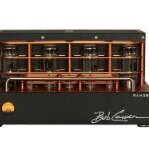
The room is under construction but will be improving each day with more pictures, videos and all things about Bob Carver LLC. founded in Feb 2022. Tube amplifiers are the main focus as they are Bob's most recent products. Feel free to ask questions for Bob or myself. The only request is that you have fun! Enjoy!1 point
-
I've seen vertical Arrays. Two shorter caps with adaptors. Stack em up. Screw mount on the bottom adaptor and run heavy gauge wire on either side to connect the stacked caps in parallel.
 1 point
 -
I have a 16” x 16” concrete paver I have used under a turntable when all I had was a wire rack system at the time. https://www.lowes.com/pd/Square-Gray-Concrete-Patio-Stone-Common-16-in-x-16-in-Actual-16-in-x-16-in/3034746 Cheap, readily available and effective. Just wrap it with some wood of your choice…😎1 point
-
just a thought about a base...make up a 2" high frame of exactly the shape/size you want and mix up some cement, pour, and then polish?1 point
-
Fall off not to my liking. https://www.homedepot.com/p/NewAge-Products-3-ft-Solid-Surface-Countertop-in-Black-Galaxy-Granite-89106/315511240#overlay need 3 of em, but they are 76 pounds each.. Thats pushing it for me to move around. Could always put on a second layer too.. with another layer of cork or rubber between.. but that might be just a little overkill. And I like the black. 🙂 But it is a total of >2x what I thought I would pay.. sigh.. 15 years ago, when I bought pieces to do an above garage apartment, stuff was alot less expensive.. But at 225+ pounds, that top should be a sufficient base for the RAM285 and the Silver Sevens1 point
-
We thought about it for a long time, "Endeavor to persevere." And when we had thought about it long enough, we declared war on the Union Lone Watie The Outlaw Josey Wales1 point
-
“Give a man a fish and feed him for a day. Don’t teach a man to fish…and feed yourself. He’s a grown man. And fishing’s not that hard.”- Ron Swanson1 point
-
The old school tube amps ran into this issue with the multi value can caps going away. The old guys started restuffing the factory cans with bundles of modern electrolytic caps inside the old can. Needing a single value could be easier to bundle inside the old can as shown in the link. Some blue shrink film and maybe it's a way out? https://www.antiquetvguy.com/WebPages/MyMethods/Electrolytic Can Restuffing/ElectrolyticCanRestuffing.html This company reproduces vintage caps.1 point
-
doesn't Cornell Dublier list on their mouser listing for those big cans "on demand" with a large order of 1000 minimum? That's 500 amps that each take two of these..., I think Cornell Dublier makes these in South Carolina, IIRC..., I am wrong a lot. I recall someone suggesting a group buy, to distribute the cost. ...just thinking out loud, not more than that as a strategy to address the change in the market.1 point
-
I think what we need are more manufacturers, particularly ones located in the US with competitive product lines and pricing.1 point
-
@radtraveller, you should reach out to @Ar9Jim, if anyone has a line on a pair of these..., he would. BTW, there are many line-source style DIY projects on Youtube nd DIYAudio sites..., some look pretty interesting..., build your own! "Throwing stones at birds" might be hoping a Carver pair shows up. There was a pair on USAUdio mart a fw weeks bck.1 point
-
Later last night, I relaxed with some HD AC/DC before bed. (About 80db at my seat) Very enjoyable. This is full range to the tektons with the 2 subs getting signal from the 285 sub outs. i imagine it would be better if I high passed the amp, used the sub outs at the eq and adjusted the subs to 110 or so.(for high spl), easy switch..I’ll try that this evening. That was straight from DAC. Did not adjust any settings on it from SS use, so some play time there in my future. 4000t is supposed to be here tomorrow..1 point
-
Your question is quite unique to your gear. So, I don't think that a "right or wrong" answer is out there - just opinion after experimention of similar set-ups. After reading all the docs and suggestions, I still think as noted before, you need to try it one way, then the other way, and see which way works best for you. To be sure, your source, your DAC, you room/environment, your preferred listening genre..., all those factors will affect your "best" configuration setup too. Note that I think (please check the documentation you have on them) these processor components you have all take line level input and give line-level output via the RCA jacks. so there is (should be) no harm in experimenting with different setup configuration ordering. Simply thinking though this, If you have the EQ, squelching or amplifying some frequencies in-line BEFORE the 4bx expander, you are feeding it attenuated levels of some frequencies - which stands to reason that the 4BX will be limited in how much it can expand those frequencies. If you have it the other way around, expanding the raw inline signal first with the 4BX, you then have the EQ doing more to adjust the frequencies to fit your room... Best to experiment. Honestly, it seems like the two units will be fighting each other. Note that an EQ is not an "amplifier" so adjustments it makes are to attenuate the gain it is fed from the source. You mentioned earlier that people have given you different/conflicting suggestions - I think you are getting conflicting opinion because people have configured this different ways, via experimentation. Like a lot of things in this hobby, you have to try a few things out to test what is best for your setup, listening room, etc.1 point
-
It would be hard not to have it as a sonic improvement, especially after considering the 285. Bob Carver has always been known for improving sound. I believe that Our Bobfather would lead us to the promised land once again. As 4krow has said the Carver promise will have your ears be the judge.1 point
-
I don't know what the EQ that you have is to answer the question correctly according to the documentation that's available in the 4BX manual. If you don't have the manual it is available here. https://www.manualslib.com/manual/1936693/Dbx-4bx.html#manual Look at page 14. Since I have the dbx200x (program route selector) it afforded me the opportunity to do a little research. One would have to determine if the EQ is an Automatic EQ or, for lack of proper terminology, a normal Manual EQ. In the dbx200x manual is this usage note section. Also read the Dynamic-Range Expanders section. I think that the JVC SEA-M9 is an automatic EQ so it should go b4 the dbx4BX in the signal path. Only my suggestion.1 point
-
"Would I rather be feared or loved? Easy. Both. I want people to be afraid of how much they love me"- Michael Scott.0 points

.jpg.70a414eed9159c7b3e9b3d46d7aaf5a2.jpg)
.jpg.1f917545a339d049a5d981e97e504425.jpg)


.jpg.71039f9f571dbcc4d47c92d907c87b59.jpg)


.jpg.a950ce20de1783b860f999be0e1f62b6.jpg)


.jpg.0585547dd5de7fb70abb4469337d9705.jpg)